FastRoute コンパイル・RouteRunner・ハンドラ実行戦略の内部実装
Slim 4 のルーティングエンジンは、Slim\Routing\*(11 クラス)、Slim\Middleware\RoutingMiddleware(1 クラス)、および Slim\Handlers\Strategies\*(4 クラス)の計 15 ファイル(953 LOC)で構成されています。設計上の最大の特徴は、「URI の正規表現照合(RoutingMiddleware)」と「ルートハンドラの実行(RouteRunner)」を 2 つの独立した PSR-15 フェーズに分離している点にあります。これにより、中間ミドルウェアがマッチ済みの Route オブジェクトやパラメータを参照してから、最内殻の RouteRunner がグループミドルウェア・ルートミドルウェア・呼び出し戦略(InvocationStrategyInterface)を順次実行できます。
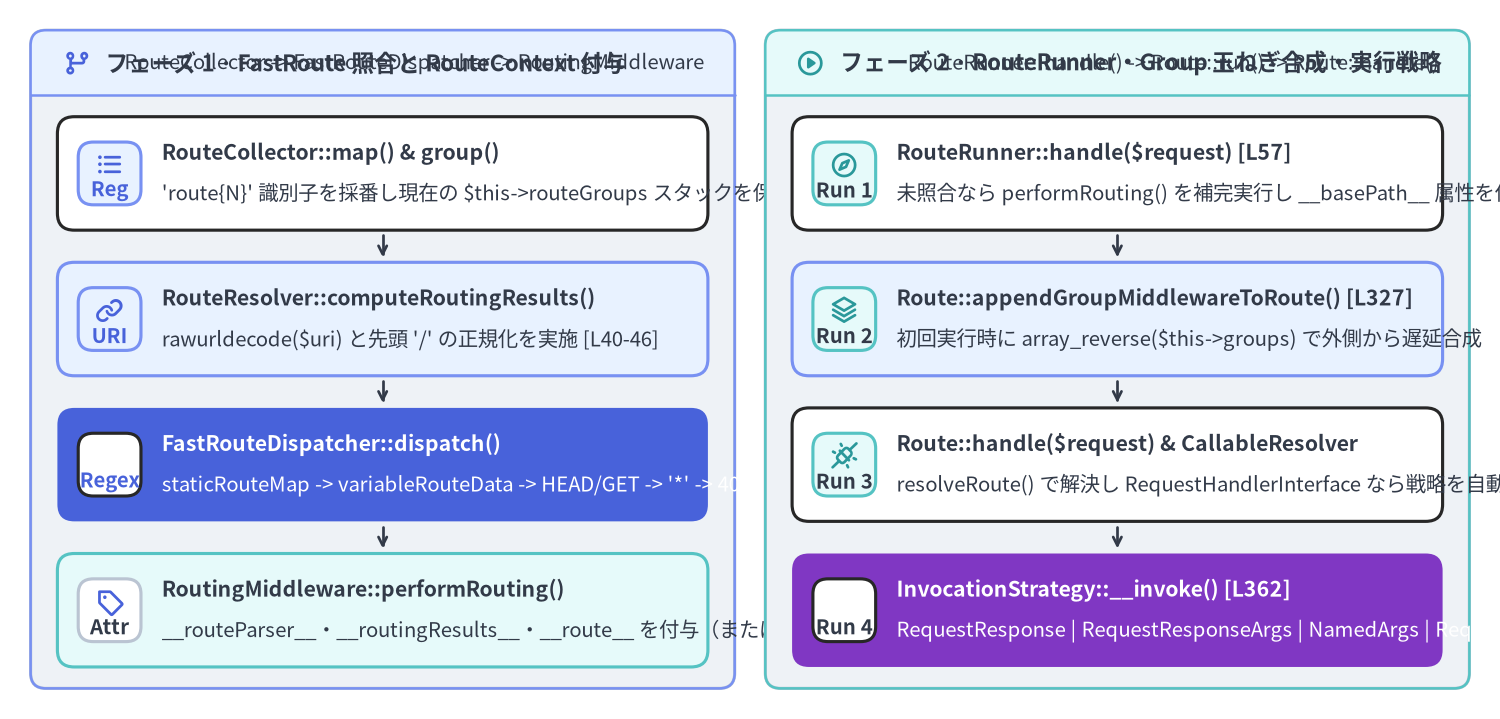
Source Code
from drawlib.canvas import save, setup
from drawlib.icons import phosphor
from drawlib.smartarts import CardList, Panel
from drawlib.styles import Colors, Styles

setup(width=196, height=94, dpi=150)

# Left Panel: Phase 1 — Route Registration & FastRoute Dispatch
p_left = Panel(
    "フェーズ 1 · FastRoute 照合と RouteContext 付与",
    "RouteCollector -> FastRouteDispatcher -> RoutingMiddleware",
    style=Styles.Neutral.patch(shape_r=2.0),
    header_style=Styles.PrimaryNeutral.patch(shape_line_width=1.2),
    text_style=Styles.DarkBold.patch(text_size=10.8),
    description_style=Styles.Dark.patch(text_size=9.8),
    icon=phosphor.git_branch,
    icon_style=Styles.PrimaryBold,
    header_variant="filled",
    header_height=8.5,
)
p_left.draw((4.0, 4.0), width=92.0, height=86.0)
lx, lw, lh = p_left.get_content_box((4.0, 4.0), width=92.0, height=86.0, padding=(3.5, 2.8))

match_steps = CardList(
    style=Styles.White,
    text_style=Styles.DarkBold.patch(text_size=10.2),
    description_style=Styles.Dark.patch(text_size=9.8),
    badge_shape="rounded_rect",
    badge_style=Styles.PrimaryNeutral,
    badge_text_style=Styles.PrimaryBold.patch(text_size=9.8),
    icon_style=Styles.PrimaryBold,
    direction="vertical",
    spacing=2.5,
    show_arrows=True,
    arrow_style=Styles.DarkBold.patch(line_arrow_head_scale=10, line_width=1.3),
)
match_steps.add(
    "RouteCollector::map() & group()",
    "'route{N}' 識別子を採番し現在の $this->routeGroups スタックを保存",
    badge_text="Reg",
    icon=phosphor.list_bullets,
)
match_steps.add(
    "RouteResolver::computeRoutingResults()",
    "rawurldecode($uri) と先頭 '/' の正規化を実施 [L40-46]",
    badge_text="URI",
    icon=phosphor.link,
    style=Styles.PrimaryNeutral,
)
match_steps.add(
    "FastRouteDispatcher::dispatch()",
    "staticRouteMap -> variableRouteData -> HEAD/GET -> '*' -> 405/404",
    badge_text="Regex",
    icon=phosphor.magnifying_glass,
    style=Styles.PrimaryFlat,
    text_style=Styles.WhiteBold.patch(text_size=10.2),
    description_style=Styles.White.patch(text_size=9.8),
    badge_style=Styles.White,
    badge_text_style=Styles.PrimaryBold.patch(text_size=9.8),
    icon_style=Styles.WhiteBold,
)
match_steps.add(
    "RoutingMiddleware::performRouting()",
    "__routeParser__・__routingResults__・__route__ を付与(または 404/405 例外)",
    badge_text="Attr",
    icon=phosphor.tag,
    style=Styles.SecondaryNeutral,
    badge_style=Styles.White.patch(shape_line_color=Colors.Gray4),
    badge_text_style=Styles.DarkBold.patch(text_size=9.8),
)
match_steps.draw(xy=lx, width=lw, height=lh)

# Right Panel: Phase 2 — RouteRunner, Group Onion & Strategy Invocation
p_right = Panel(
    "フェーズ 2 · RouteRunner・Group 玉ねぎ合成・実行戦略",
    "RouteRunner::handle() -> Route::run() -> Route::handle()",
    style=Styles.Neutral.patch(shape_r=2.0),
    header_style=Styles.SecondaryNeutral.patch(shape_line_width=1.2),
    text_style=Styles.DarkBold.patch(text_size=10.8),
    description_style=Styles.Dark.patch(text_size=9.8),
    icon=phosphor.play_circle,
    icon_style=Styles.SecondaryBold,
    header_variant="filled",
    header_height=8.5,
)
p_right.draw((100.0, 4.0), width=92.0, height=86.0)
rx, rw, rh = p_right.get_content_box((100.0, 4.0), width=92.0, height=86.0, padding=(3.5, 2.8))

exec_steps = CardList(
    style=Styles.White,
    text_style=Styles.DarkBold.patch(text_size=10.2),
    description_style=Styles.Dark.patch(text_size=9.8),
    badge_shape="rounded_rect",
    badge_style=Styles.SecondaryNeutral,
    badge_text_style=Styles.DarkBold.patch(text_size=9.8),
    icon_style=Styles.SecondaryBold,
    direction="vertical",
    spacing=2.5,
    show_arrows=True,
    arrow_style=Styles.DarkBold.patch(line_arrow_head_scale=10, line_width=1.3),
)
exec_steps.add(
    "RouteRunner::handle($request) [L57]",
    "未照合なら performRouting() を補完実行し __basePath__ 属性を付与",
    badge_text="Run 1",
    icon=phosphor.compass,
)
exec_steps.add(
    "Route::appendGroupMiddlewareToRoute() [L327]",
    "初回実行時に array_reverse($this->groups) で外側から遅延合成",
    badge_text="Run 2",
    icon=phosphor.stack,
    style=Styles.PrimaryNeutral,
)
exec_steps.add(
    "Route::handle($request) & CallableResolver",
    "resolveRoute() で解決し RequestHandlerInterface なら戦略を自動切替",
    badge_text="Run 3",
    icon=phosphor.plugs_connected,
)
exec_steps.add(
    "InvocationStrategy::__invoke() [L362]",
    "RequestResponse | RequestResponseArgs | NamedArgs | RequestHandler",
    badge_text="Run 4",
    icon=phosphor.lightning,
    style=Styles.AccentFlat,
    text_style=Styles.WhiteBold.patch(text_size=10.2),
    description_style=Styles.White.patch(text_size=9.8),
    badge_style=Styles.White,
    badge_text_style=Styles.DarkBold.patch(text_size=9.8),
    icon_style=Styles.WhiteBold,
)
exec_steps.draw(xy=rx, width=rw, height=lh)

save()
1. ルート収集とプレフィックス・グループスタック(RouteCollectorProxy & RouteCollector)
ネストされた group() 呼び出しがプレフィックスとグループ階層を蓄積する仕組み
以下のようにネストされたルートグループを定義したとします。
$app->group('/v1', function (RouteCollectorProxy $group) {
    $group->group('/users', function (RouteCollectorProxy $users) {
        $users->get('/{id}', UserController::class . ':show');
    })->add(UserScopeMiddleware::class);
})->add(ApiVersionMiddleware::class);
この登録処理では、RouteCollectorProxy(Slim/Routing/RouteCollectorProxy.php)、RouteCollector(Slim/Routing/RouteCollector.php)、RouteGroup(Slim/Routing/RouteGroup.php)の3クラスが同期的に連携します。
- グループプレフィックスの連結(
Slim/Routing/RouteCollectorProxy.php:165-180): 各RouteCollectorProxyはprotected string $groupPattern(Slim\App本体では'')を保持しています。$proxy->group($pattern, $callable)や$proxy->map(...)が呼ばれると、$pattern = $this->groupPattern . $patternによって親プレフィックスを先頭に結合してから$this->routeCollectorに委譲します。 - グループスタックの Push / Pop(
Slim/Routing/RouteCollector.php:230-239):RouteCollector::group()は連結済み$patternを持つ子RouteCollectorProxyとRouteGroupを生成し、$this->routeGroups[]スタックに Push した状態で$routeGroup->collectRoutes()を実行し、完了直後にarray_pop($this->routeGroups)で Pop します。// Slim/Routing/RouteCollector.php:230-239 public function group(string $pattern, $callable): RouteGroupInterface { $routeGroup = $this->createGroup($pattern, $callable); $this->routeGroups[] = $routeGroup; $routeGroup->collectRoutes(); array_pop($this->routeGroups); return $routeGroup; } - ルート識別子
'route{N}'の採番とグループ配列のスナップショット(Slim/Routing/RouteCollector.php:268-300):collectRoutes()実行中に呼ばれた$users->get(...)はRouteCollector::map()に到達し、その時点でアクティブな$this->routeGroups配列のコピー([RouteGroup('/v1'), RouteGroup('/v1/users')])と連番カウンタ$this->routeCounterをnew Route(...)(Slim/Routing/Route.php:120-141)に渡します。生成されたRouteは'route' . $identifier('route0'、'route1'等)を識別子として$this->routes['route0'] = $routeに格納されます。
2. Dispatcher と FastRouteDispatcher:Nikic FastRoute の拡張実装
FastRoute の遅延コンパイルとキャッシュファイル出力(Slim/Routing/Dispatcher.php:24-58)
Slim\Routing\Dispatcher は $app->get() の登録時には正規表現ツリーをコンパイルせず、最初の dispatch() または getAllowedMethods() 呼び出し時に Dispatcher::createDispatcher() で遅延生成します。
// Slim/Routing/Dispatcher.php:30-54
$routeDefinitionCallback = function (FastRouteCollector $r): void {
    $basePath = $this->routeCollector->getBasePath();

    foreach ($this->routeCollector->getRoutes() as $route) {
        $r->addRoute($route->getMethods(), $basePath . $route->getPattern(), $route->getIdentifier());
    }
};

$cacheFile = $this->routeCollector->getCacheFile();
if ($cacheFile) {
    $dispatcher = \FastRoute\cachedDispatcher($routeDefinitionCallback, [
        'dataGenerator' => GroupCountBased::class,
        'dispatcher' => FastRouteDispatcher::class,
        'routeParser' => new Std(),
        'cacheFile' => $cacheFile,
    ]);
} else {
    $dispatcher = \FastRoute\simpleDispatcher($routeDefinitionCallback, [
        'dataGenerator' => GroupCountBased::class,
        'dispatcher' => FastRouteDispatcher::class,
        'routeParser' => new Std(),
    ]);
}
ここで FastRoute に登録されるハンドラ値(第3引数)が、クロージャやオブジェクトではなく 文字列識別子 $route->getIdentifier()('route0' 等) である点に注目してください。文字列のみで構成されているため、\FastRoute\cachedDispatcher() はコンパイル済みの静的連想配列と正規表現チャンク配列を var_export()(<?php return ...;)でそのまま $cacheFile に書き出すことができ、本番環境の PHP-FPM ワーカーは OPcache から正規表現テーブルをゼロコストで読み込めます。
なぜ FastRouteDispatcher は GroupCountBased をオーバーライドするのか?(Slim/Routing/FastRouteDispatcher.php:15-116)
Slim\Routing\FastRouteDispatcher は FastRoute\Dispatcher\GroupCountBased を継承し、dispatch($httpMethod, $uri)(33〜59 行目)と getAllowedMethods(string $uri)(92〜115 行目)を独自実装で置き換えています。
// Slim/Routing/FastRouteDispatcher.php:33-59
public function dispatch($httpMethod, $uri): array
{
    $routingResults = $this->routingResults($httpMethod, $uri);
    if ($routingResults[0] === self::FOUND) {
        return $routingResults;
    }

    // For HEAD requests, attempt fallback to GET
    if ($httpMethod === 'HEAD') {
        $routingResults = $this->routingResults('GET', $uri);
        if ($routingResults[0] === self::FOUND) {
            return $routingResults;
        }
    }

    // If nothing else matches, try fallback routes
    $routingResults = $this->routingResults('*', $uri);
    if ($routingResults[0] === self::FOUND) {
        return $routingResults;
    }

    if (!empty($this->getAllowedMethods($uri))) {
        return [self::METHOD_NOT_ALLOWED, null, []];
    }

    return [self::NOT_FOUND, null, []];
}
- $O(1)$ 静的ハッシュ照合とチャンク正規表現照合(
routingResults()、67〜85 行目): まずisset($this->staticRouteMap[$httpMethod][$uri])を $O(1)$ で検査し、静的ルートでなければ親クラスの$this->dispatchVariableRoute($this->variableRouteData[$httpMethod], $uri)(約10ルート単位でグループ化された合成正規表現照合)を呼び出します。 - RFC 2616 準拠の
HEAD -> GETフォールバック(41〜46 行目):HEADリクエストに対応する明示的なHEADルートが存在しない場合、自動的にroutingResults('GET', $uri)へフォールバックします。その後、Slim\App::handle()の末尾(Slim/App.php:218-222)でレスポンスボディが空ストリームに差し替えられます。 - ワイルドカード
'*'メソッドフォールバック(49〜52 行目):$app->map(['*'], ...)で登録された全メソッド共通ルートへのフォールバックを処理します。 getAllowedMethods(string $uri)の単一 URI メモ化キャッシュ(92〜115 行目): 54 行目でMETHOD_NOT_ALLOWED(405)と判定された直後、RoutingMiddleware::performRouting()(Slim/Middleware/RoutingMiddleware.php:80)が$routingResults->getAllowedMethods()を再度呼び出します。同じ URI に対して全メソッドの正規表現テーブルを2回走査する無駄を防ぐため、FastRouteDispatcherはprivate ?string $allowedMethodsUriとprivate array $allowedMethods(20〜25 行目、94〜96 行目)に直前の URI の許可メソッド配列をメモ化しています。
3. RoutingMiddleware・RouteContext と Route::run() のグループ玉ねぎ合成
Source Code
from drawlib.canvas import save, setup
from drawlib.icons import phosphor
from drawlib.smartarts import CardList, Panel
from drawlib.styles import Colors, Styles

setup(width=196, height=90, dpi=150)

# Left Panel: Route::appendGroupMiddlewareToRoute()
p_left = Panel(
    "Route::appendGroupMiddlewareToRoute()",
    "Slim/Routing/Route.php:315-337 (array_reverse)",
    style=Styles.Neutral.patch(shape_r=2.0),
    header_style=Styles.PrimaryNeutral.patch(shape_line_width=1.2),
    text_style=Styles.DarkBold.patch(text_size=10.8),
    description_style=Styles.Dark.patch(text_size=9.8),
    icon=phosphor.arrows_in_line_horizontal,
    icon_style=Styles.PrimaryBold,
    header_variant="filled",
    header_height=8.5,
)
p_left.draw((4.0, 4.0), width=92.0, height=82.0)
lx, lw, lh = p_left.get_content_box((4.0, 4.0), width=92.0, height=82.0, padding=(3.5, 3.0))

grp_steps = CardList(
    style=Styles.White,
    text_style=Styles.DarkBold.patch(text_size=10.2),
    description_style=Styles.Dark.patch(text_size=9.8),
    badge_shape="rounded_rect",
    badge_style=Styles.PrimaryNeutral,
    badge_text_style=Styles.PrimaryBold.patch(text_size=9.8),
    icon_style=Styles.PrimaryBold,
    direction="vertical",
    spacing=2.6,
    show_arrows=True,
    arrow_style=Styles.DarkBold.patch(line_arrow_head_scale=10, line_width=1.3),
)
grp_steps.add(
    "1. 内側ディスパッチャ (inner = this->middlewareDispatcher)",
    "route->add() で登録されたルート固有ミドルウェアと Route 本体",
    badge_text="Inner",
    icon=phosphor.play_circle,
)
grp_steps.add(
    "2. 新規の外側 MiddlewareDispatcher(inner) 生成",
    "inner を中心核カーネルとして新しいディスパッチャを生成 [L329-330]",
    badge_text="Wrap",
    icon=phosphor.stack,
    style=Styles.PrimaryNeutral,
)
grp_steps.add(
    "3. foreach (array_reverse(this->groups) as group)",
    "内側の RouteGroup から外側の RouteGroup の順で add() [L332-334]",
    badge_text="Reverse",
    icon=phosphor.arrows_down_up,
    style=Styles.PrimaryFlat,
    text_style=Styles.WhiteBold.patch(text_size=10.2),
    description_style=Styles.White.patch(text_size=9.8),
    badge_style=Styles.White,
    badge_text_style=Styles.PrimaryBold.patch(text_size=9.8),
    icon_style=Styles.WhiteBold,
)
grp_steps.add(
    "4. 最終的な実行順序",
    "外側 Group MW -> 内側 Group MW -> Route MW -> Route::handle()",
    badge_text="Order",
    icon=phosphor.check_circle,
)
grp_steps.draw(xy=lx, width=lw, height=lh)

# Right Panel: 4 Handler Invocation Strategies
p_right = Panel(
    "4種の標準ハンドラ実行戦略 (Strategies)",
    "Slim/Handlers/Strategies/*.php",
    style=Styles.Neutral.patch(shape_r=2.0),
    header_style=Styles.SecondaryNeutral.patch(shape_line_width=1.2),
    text_style=Styles.DarkBold.patch(text_size=10.8),
    description_style=Styles.Dark.patch(text_size=9.8),
    icon=phosphor.code,
    icon_style=Styles.SecondaryBold,
    header_variant="filled",
    header_height=8.5,
)
p_right.draw((100.0, 4.0), width=92.0, height=82.0)
rx, rw, rh = p_right.get_content_box((100.0, 4.0), width=92.0, height=82.0, padding=(3.5, 3.0))

strat_list = CardList(
    style=Styles.White,
    text_style=Styles.DarkBold.patch(text_size=10.2),
    description_style=Styles.Dark.patch(text_size=9.8),
    badge_shape="rounded_rect",
    badge_style=Styles.SecondaryNeutral,
    badge_text_style=Styles.DarkBold.patch(text_size=9.8),
    icon_style=Styles.SecondaryBold,
    direction="vertical",
    spacing=2.6,
)
strat_list.add(
    "RequestResponse(デフォルト戦略)",
    "req->withAttribute(k, v) を付与し fn(req, res, args) を呼出",
    badge_text="Default",
    icon=phosphor.star,
    style=Styles.PrimaryNeutral,
)
strat_list.add(
    "RequestResponseArgs",
    "位置引数として展開:fn(req, res, ...array_values(args))",
    badge_text="Pos",
    icon=phosphor.list_numbers,
)
strat_list.add(
    "RequestResponseNamedArgs (PHP 8.0+)",
    "連想配列キーを名前付き引数として展開:fn(req, res, ...args)",
    badge_text="Named",
    icon=phosphor.brackets_curly,
)
strat_list.add(
    "RequestHandler(PSR-15 自動切替)",
    "Route::handle() [L353] で RequestHandlerInterface 実装時に自動選択",
    badge_text="PSR-15",
    icon=phosphor.lightning,
    style=Styles.AccentFlat,
    text_style=Styles.WhiteBold.patch(text_size=10.2),
    description_style=Styles.White.patch(text_size=9.8),
    badge_style=Styles.White,
    badge_text_style=Styles.DarkBold.patch(text_size=9.8),
    icon_style=Styles.WhiteBold,
)
strat_list.draw(xy=rx, width=rw, height=lh)

save()
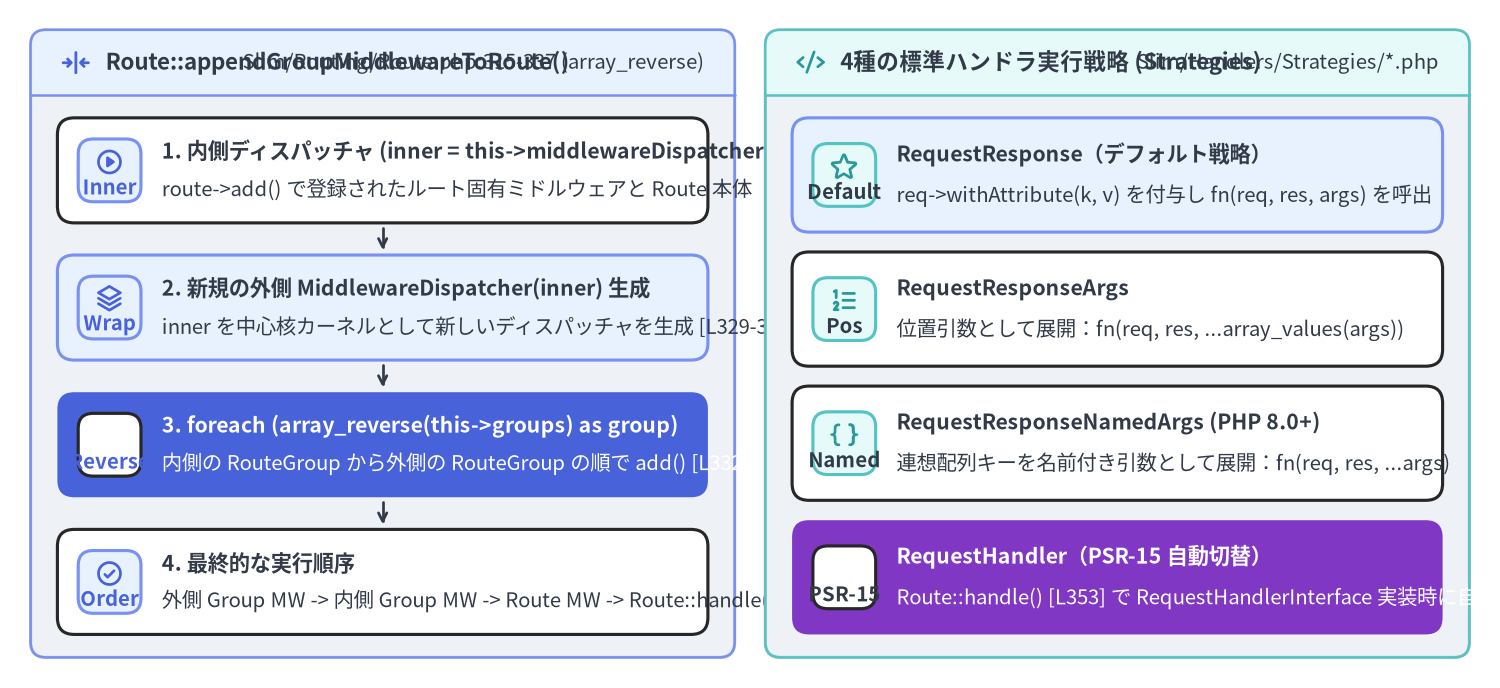
なぜ Route::appendGroupMiddlewareToRoute() は $this->groups を逆順ループするのか?(Slim/Routing/Route.php:327-337)
ネストされたグループ内でルートが定義される際(OuterGroup -> InnerGroup -> Route)、ルート固有のミドルウェア($route->add(...))はグループコールバックの内部で登録されるのに対し、外側のグループミドルウェア($outerGroup->add(...))は collectRoutes() が終了した後にメソッドチェーンで登録されます。
そのため、Route はコンストラクタ時点ではグループのミドルウェアを取り込むことができません。代わりに、最初のリクエストで Route::run()(Slim/Routing/Route.php:315-322)が呼ばれた瞬間に一度だけ appendGroupMiddlewareToRoute() を実行し、既存の $this->middlewareDispatcher($inner)を核とする新しい MiddlewareDispatcher($inner) を作り、array_reverse($this->groups) の順でグループミドルウェアを追加します。
// Slim/Routing/Route.php:327-337
protected function appendGroupMiddlewareToRoute(): void
{
    $inner = $this->middlewareDispatcher;
    $this->middlewareDispatcher = new MiddlewareDispatcher($inner, $this->callableResolver, $this->container);

    foreach (array_reverse($this->groups) as $group) {
        $group->appendMiddlewareToDispatcher($this->middlewareDispatcher);
    }

    $this->groupMiddlewareAppended = true;
}
MiddlewareDispatcher::add() は後入れ先出し(LIFO)であるため、array_reverse($this->groups) によって内側の InnerGroup を先に add() し、外側の OuterGroup を後から add() することで、実行時には「OuterGroup -> InnerGroup -> Route 固有ミドルウェア -> Route::handle()」という直感通りの外から内への実行順序が成立します。
PSR-15 RequestHandler 戦略への自動切り替え(Slim/Routing/Route.php:342-363)
Route::run() の最内殻にある Route::handle(ServerRequestInterface $request) は、CallableResolver::resolveRoute() で解決された $callable が [RequestHandlerInterface, 'handle'] の形式であるかどうかを検査します。
// Slim/Routing/Route.php:342-363
public function handle(ServerRequestInterface $request): ResponseInterface
{
    if ($this->callableResolver instanceof AdvancedCallableResolverInterface) {
        $callable = $this->callableResolver->resolveRoute($this->callable);
    } else {
        $callable = $this->callableResolver->resolve($this->callable);
    }
    $strategy = $this->invocationStrategy;

    $strategyImplements = class_implements($strategy);

    if (
        is_array($callable)
        && $callable[0] instanceof RequestHandlerInterface
        && !in_array(RequestHandlerInvocationStrategyInterface::class, $strategyImplements)
    ) {
        $strategy = new RequestHandler();
    }

    $response = $this->responseFactory->createResponse();
    return $strategy($callable, $request, $response, $this->arguments);
}
アプリケーションのデフォルト戦略が RequestResponse のままであっても、ルートハンドラが PSR-15 RequestHandlerInterface を実装していれば 353〜359 行目で自動的に new RequestHandler() 戦略へ切り替わり、不要な空 Response 引数を渡さずに $callable($request) を直接呼び出します。
続いて 第5章: ErrorMiddleware・ErrorHandler・レンダラ群 に進み、ルーティングやハンドラ実行中に発生した例外がどのように捕捉・コンテンツ交渉・描画されるかを詳しく見ていきましょう。